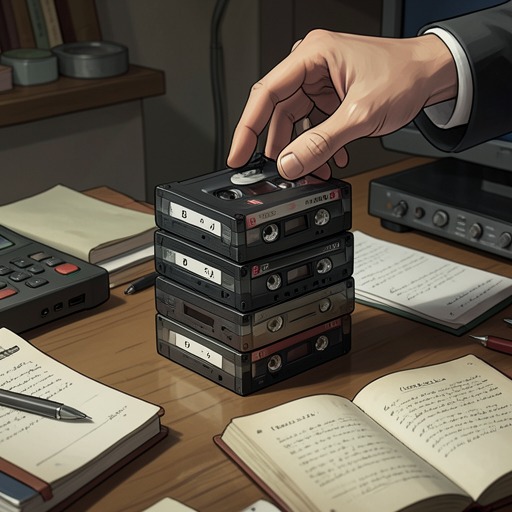
Hannah’s cassette tapes
Thirteen Reasons WhyHannah’s cassette tapes turn a private voice into a carefully ordered message that must travel. Numbered by side, governed by rules to listen and pass them on, and backed by the threat of public copies, they make the act of hearing part of the story’s burden: each recipient is not only an audience but a link in a chain that must continue.
Appearance and Sequence
The tapes first arrive in a shoebox-sized package left at the front door for Clay Jensen. Inside, beneath a roll of bubble wrap, are seven loose audiotapes. Their dark blue numbers, possibly painted with nail polish, mark each side separately: one and two on the first tape, three and four on the next, and so on. The final tape bears a thirteen on one side and no number on its back. The numbering gives a physical order to Hannah’s account before Clay knows what it contains, and the missing number on the last side makes the sequence feel deliberately bounded rather than open-ended.
The object also depends on a playback device that is no longer taken for granted. Clay wonders whether he can play tapes at all; the solution is the old stereo on the workbench in the garage, a yard-sale purchase his father does not mind exposing to sawdust or paint. The recordings therefore reach their listener through ordinary, slightly makeshift equipment: a package opened with kitchen scissors, tapes unrolled from protective wrapping, and a machine kept in a garage because it is old enough not to require special care.
Hannah’s Instructions and Stakes
Hannah frames the recordings as an account of her life and, more specifically, of why her life ended. She tells listeners that they are among the reasons, while withholding at first which tape brings each person into the story. She promises that the recipient’s name will appear, making the sequence at once a personal address and a staged revelation. The tapes do not simply recount what happened; they announce that listening will expose the listener’s place in it.
The rules are concise: listen, then pass the tapes on. After all thirteen sides have been heard, the listener must rewind them, return them to the box, and send them to whoever follows. Hannah’s phrasing links the number of sides to the claim that every story has thirteen sides, turning the physical format into a model for multiple accounts and consequences. The requirement to rewind is practical, but it also makes the next person’s access depend on the previous listener completing the task.
Hannah anticipates refusal. She says she has made a copy, and that the copies will be released publicly if the package fails to pass through everyone. The threat converts the chain from a request into an enforceable condition: a listener may resent the message or want to stop it, but cannot treat the tapes as disposable private property without risking wider exposure. Her warning that this was not a spur-of-the-moment decision reinforces the deliberate design behind the recordings and their circulation.
Listening as a Chain of Responsibility
The tapes’ order gives the unfolding account a material structure. Clay encounters the recordings as seven objects but hears thirteen numbered sides; to move forward, he must handle and exchange the physical tape in the player. Later, after Tony reveals that he has the second set, Clay recognizes that Hannah’s contingency was real. Tony says he is the ninth person he has had to follow, and Clay identifies his own place when he pulls out the fifth tape: the dark blue nine marks him as listener number nine. The number turns an abstract accusation into a position within a sequence.
Clay’s handling of the recordings makes that position visible. He takes the sixth tape from his pocket and swaps it for the one in the Walkman, continuing the ordered process even while asking Tony for the full story. The tapes are therefore not merely a container for Hannah’s voice: their order directs the timing of what Clay can hear, and the physical act of changing sides accompanies his effort to understand what has happened.
At the end of one side, the tape vibrates as it reaches the spool’s limit, clicks over, and continues. The brief mechanical pause exposes the medium’s limits: a voice recorded in the past can only continue when the device advances to the next side. Across the seven tapes and thirteen stories, a slight static hum persists beneath Hannah’s words. Once her voice stops, Clay hears the hum more clearly, a steady acoustic remainder that makes the recordings’ duration and material presence perceptible even in silence.
Transfer and Afterlife
Clay eventually takes up the obligation to pass the package onward. He waits for the post office to open, wraps the shoebox in a brown paper bag secured with packing tape, leaves off a return address, and mails it to Jenny Kurtz. The act echoes the tapes’ original arrival while changing the identity of the next recipient: Clay becomes not just a listener marked by Hannah’s sequence but its courier. He expects the tapes to change how Jenny sees life and the world, extending the recordings’ effects beyond his own listening.
The chain’s continuation does not erase what the tapes have done to Clay. After mailing them, he thinks of Mr. Porter’s classroom and the empty desk one place to the left, where Hannah used to sit. The package can move on; the absence at school remains. That contrast gives the tapes their double force: they carry Hannah’s words into another person’s future while binding their listeners to what cannot be restored in the present.